
Quick Reference: What Matters When Selecting Herbicides
Note, this section describes guidelines, and there often is not one single answer to what strategy and herbicide is best, as it depends on many factors.
Target weeds: What weeds, what density, and what growth stage? Are contact herbicides sufficient? Or are systemics required
Crop: What crop and growth stage? Is there a significant risk in hitting the crop? Is it a problem? How sensitive is the crop to the herbicide and may residue levels be an issue?
Mode of action: In general, two strategies are common. Contact herbicides which work well if the weeds are small, or if crop safety is a concern. Systemic herbicides, if the weeds are large, there is low risk when hitting the crop, or if the operator has good control over droplet quality, precision, wind conditions, or it is a part of a special strategy.
Formulation type: As a rule of thumb, water solubles and emulsions are fine, and formulations that make suspensions are not. However, ensure stability over time, and do not leave the herbicide in the system for days without cleaning!
Water quality: Ensure no iron particles are present. In general hard water is problematic especially with pelargonic acid. In general the higher the hardness the worse, ideally stay below 1mmol/L (~5.6 dGH). Measure pH and make sure it is compatible with the herbicide used. Please note, pH and water hardness is not the same!
Environmental effects: Although AX-1 has extremally low drift, wind will affect precision. Make sure you adjust safety zones accordingly. Consider the temperature both at night and day, as some herbicides or mixes may become unstable if it becomes too hot or cold.
Droplet properties: When using a new mix, or changing location where the robot operates, always do a jar test, check areal dosage, coefficient of variation, droplet positioning, and presence of secondary droplets. This can be accomplished with Kilters droplet measurement tool, and water sensitive paper.
The long version
What Is Herbicide Compatibility?
Herbicide compatibility is the ability of two or more herbicides, or herbicides and adjuvants, to be mixed and applied together without reducing efficacy or causing physical or chemical issues.
Typical Formulations: What Usually Works and What Does Not
Formulations differ in stability, mixing behavior, and droplet performance. The notes below describe common patterns and practical limits.
-
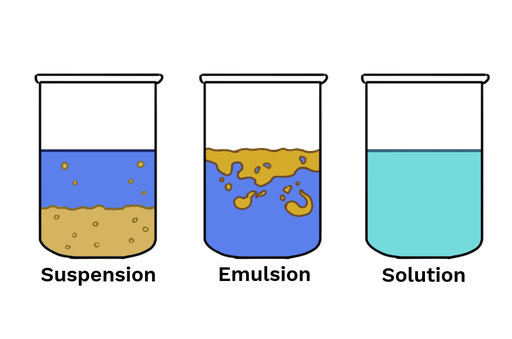
Water-soluble formulations (solutions): Usually perform well. They mix easily, remain uniform, and are typically compatible with single-droplet technology.
-
Emulsions (EC, EW, ME): Usually perform well if they remain stable. They are acceptable when they do not coagulate and when any phase separation is minor and easily re-mixed with gentle agitation. They usually have adjuvants present in the herbicide which reduces the surface tension of water.
-
Suspensions (SC, SE, OD, flowables): Often problematic because particles can settle, agglomerate, or clog. They may work if the suspension is stable with limited or no agitation and if particle size is below 70 um. Kilter does not recommend such formulations.
-
Dry formulations (WG, DF, WP): Usually poor compatibility. They require thorough mixing and can leave grit or sediment that affects droplet formation. Use only if a jar test shows uniform dispersion that remains stable. Kilter does not recommend such formulations.
Mixing Risks and Water/Temperature Considerations
Common risks when mixing products include precipitation, destabilisation of emulsions, viscosity changes, and pH shifts that reduce performance or increase crop risk. Temperature and water quality can amplify these problems.
-
Temperature concerns: Cold water can slow or prevent dissolution, and heat can accelerate degradation or destabilize emulsions. Mix at moderate temperatures when possible and avoid extreme heat or cold. This is especially true for water solubles and emulsions (oil based substances).
-
Water hardness: High levels of calcium or magnesium can reduce performance of some actives and increase precipitation. Use water conditioners if needed and follow label guidance. A common issue is the formation of insoluble substances when using hard water and pelargonic acid (Finalsan, Slasher, Beloukha etc.).This issue is often characterised by the formation of a butter like substance which clogs the filters.
-
Water pH: Alkaline water can speed hydrolysis of some herbicides, while very low pH can affect stability of others. Adjust only if label guidance supports it.
- Magnetic particles: There are magnets in the system which are sensitive to the buildup of metallic particles.
Compatibility Issues
Common Issues to Avoid
-
Leaving herbicide in the system for days, leading to settling, crystallization, or residue buildup
-
Mixing two herbicides or adjuvants that react and reduce efficacy or stability
-
Temperature extremes that destabilize emulsions or slow dissolution (Especially if leaving the machine over night)
-
Poor water quality, especially when moving to a new location with different hardness or pH
-
Skipping the jar test or using a mix that does not re-suspend easily after sitting
Best Practices for Herbicide Compatibility Check
Always follow label instructions and perform a jar test before tank mixing. Add products to the spray tank in the recommended order.
Field-Ready Mix Test for AX-1 (Farmer Checklist)
Use the steps below to confirm a mix is compatible with the AX-1 system and performs as intended. If any step fails, do not use the mix.
Step 1: Pre-check formulation and water quality
Confirm the formulation type and whether it is likely to perform well. Assess water quality for the available sources (hardness, pH, temperature). If water quality is uncertain or variable, consider using demineralised water.
Step 2: Overnight jar test
Prepare a jar test at the intended ratios and leave it overnight. AX-1 can run 24/7, so the mixture must remain stable even when sitting for several hours without circulation. If separation, sediment, gelling, or crystals form and do not re-mix easily, reject the mix.
Step 3: Short tank check
Mix a small batch and put it in the tank. Run "Prepare nozzles" a few times to confirm stable flow and no blockage or settling.
Step 4: Droplet volume and distribution test
Verify droplet volume and distribution. Check the coefficient of variation (CoV) and confirm areal dosage. Adjust the spray unit if needed.
Step 5: Spot-check on weeds
Run over a small area with visible weeds. Confirm droplet placement and hit rate. This is easiest to observe on dry soil.
Step 6: Secondary droplet check (especially for systemics)
Place water-sensitive paper under weeds and spray. Look for secondary droplets and estimate how many are present. The image below shows typical behaviour. In general, the fewer secondary droplets, the better.
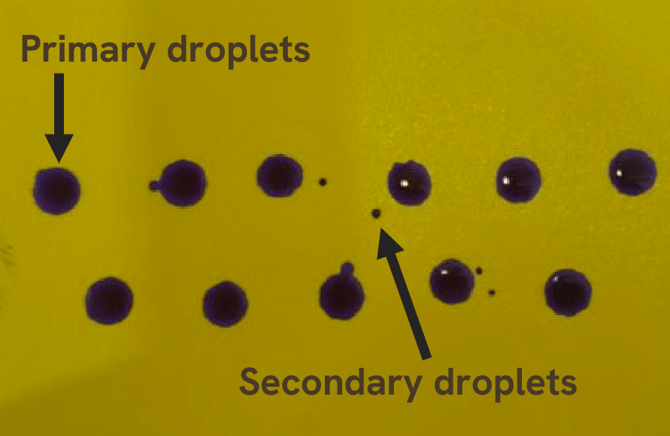
As an example, the following image shows a very bad case, which may occur for example when "prepare nozzles" is not run.

An increased number of secondary droplets raises the risk of unintended crop contamination, as spray accuracy may be compromised and reduced.
Contact herbicides act primarily at the point of droplet impact. Therefore, small off-target droplets generally have limited biological impact. In contrast, systemic herbicides are absorbed and transported throughout the plant, meaning that even small amounts reaching nearby crops can cause unintended damage. For this reason, extra caution is required when applying systemic herbicides near sensitive crops.
Note for high-precision, single-droplet systems: Droplet formation is strongly influenced by surface tension. Excessively high surface tension can lead to inconsistent droplet detachment, while excessively low surface tension may increase the formation of secondary droplets.
Safety and Environmental Considerations
Use appropriate personal protective equipment (PPE) and avoid application under conditions that may lead to drift or runoff. Proper herbicide selection supports sustainable weed management.