
Example
Herbicide A has a label rate of 2 L/ha for the target crop. With a tank volume of 50 L and a machine output of 278 L/ha, the required amount of herbicide per tank is: 2 L/ha × 50 L ÷ 278 L/ha = 0.360 L (360 mL).
When calibrated, the machine applies 278 L/ha of herbicide mix — but only over treated areas. For example, at 10% weed coverage, actual consumption is approximately 27.8 L/ha. However, current regulations require that herbicide concentration is calculated assuming the entire area is treated, so always use 278 L/ha as the basis for dosage calculations. Check your local regulations, as requirements may vary by region.
Disclaimer:
This calculator only estimates herbicide and adjuvant concentrations from your inputs. It is the operator's responsibility to ensure the products used are approved for the target crop and that the dose rate is legal for the relevant crop, region, and country. Always follow the product label and applicable regulations. No liability is accepted for use of this calculator.
The AX-1 sprayer applies herbicide at a fixed nominal rate of 278 L/ha over treated areas. Calibration ensures the actual output matches this target. The procedure uses a patternator tool and takes approximately 15–20 minutes.
How to calibrate the dosed volume
Preparation
In order to ensure proper calibration, always do it with the correct herbicide in the system, as the herbicide formulation will affect fluid properties, and the final result.
To access the calibration screen, navigate to Settings > Spraying > Periodic inspection > Step 12, then select the Liquid distribution section. Ensure the pump is enabled before proceeding.
To perform the calibration, a patternator tool illustrated below is needed. There are two parts to the tool, the lower part is split into 42 containers, each collecting droplets for the respective droplet generator. This part can detect malfunctions in single droplet generators.
The upper part is measuring the average volume dosed by the entire spray unit, and is used to calibrate the areal dosage. If the machine is calibrated properly, the nominal herbicide mixture application rate is 278 L/Ha, but only within treated areas.
In both cases, there are 3 lines, the middle line is the nominal value, and the upper and lower line are acceptable limits after calibration is complete.
The first part of the test fires 1000 droplets into each of the 42 measurement columns and measures the coefficient of variation. The second part, fires 3000 droplets from each droplet generator, and measures the average for a whole spray module, and is used to calibrate the ejected volume, and hence areal dosage.
Perform calibration
-
Run Prepare nozzles and wait for it to complete.
- Attach the patternator tool
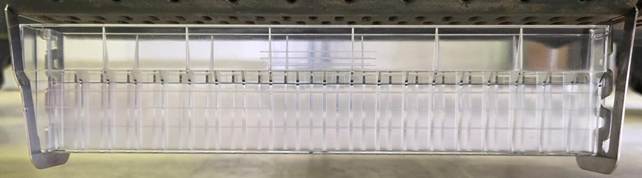
- Run Coefficient of variation test and wait for it to complete. The first test criterion is not mandatory to pass when doing calibration only, but if there are any deviations, it is a good indicatior of nozzle malfunction.
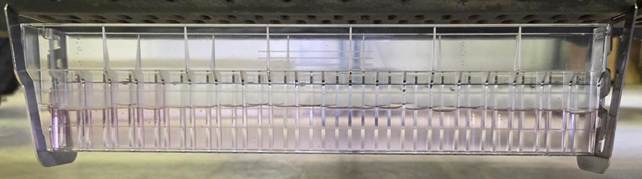
- Without emptying the collector, run Area dosage test and wait for it to complete. when the tool is on a level surface, the bottom of the fluid surface, should be as close to the middle line as possible, and it must be within the upper and lower limit lines.
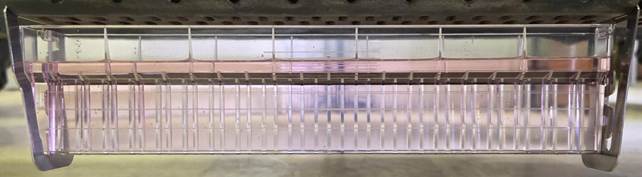
- If the volume is too high, or too low, press the Droplet calibration, select the deviating spray unit, and move the slider to change the volume. Then redo the test.
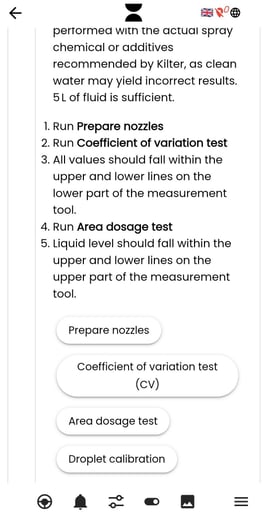
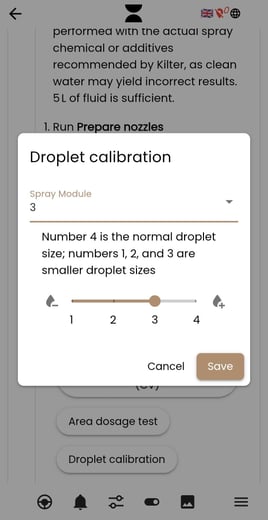
Once calibration is complete, the herbicide mix dosage should be within the acceptable limits around the nominal 278 L/ha application rate. If results remain outside acceptable limits after repeated adjustment, contact technical support.