![kilterlogo big_big.png]](https://learn.kiltersystems.com/hs-fs/hubfs/kilterlogo%20big_big.png?height=40&name=kilterlogo%20big_big.png)
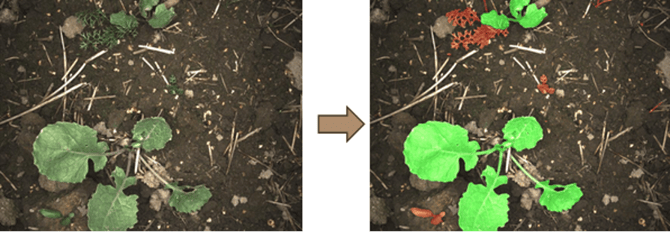
At the heart of the AX-1's weed detection system lies the Kilter classifier. The classifier is built by letting a large machine learning model process thousands of annotated images from the field, so it can learn to separate weed plants from crops or soil.
Deploying a Classifier in a New Crop
Before using the AX-1 in a new crop for the first time, Kilter will make a recommendation on how to ensure a successful treatment. These recommendations will be in one of three general categories:
- ✅ The classifier is well-tested and deployed on a number of other farms. No further action is needed before deployment.
- ⏯️ The classifier is well-tested, but only on a limited number of other farms, or in a different geographical area. Kilter may configure the classifier to be extra careful during the first treatments. If possible, it is highly recommended to collect some data from the farm on which the classifier is being deployed.
- 🔜 The classifier is still unproven and requires more data before deployment.
As of 2024, Kilter has tested and commercialized classifiers in the following crops:
- Red Beets
- Carrot
- Celeriac
- Celery
- Corn salad
- Onion (Cepa and Shallot)
- Parsnip
- Rocket salad
- Root parsley
- Rutabaga
- Spinach
Whether these fall into category 1✅ or 2⏯️ depends on the data used for each model and the specifics of the given farm.
In addition, the following classifiers are in the development stage:
- Arnica
- Broccolini
- Chicory
- Coriander
- Curly-leaf parsley
- Dill
- Flat-leaf parsley
- Iceberg lettuce
- Mint
- Pumpkin
- Strawberry
If the Classifier Needs More Data
Kilter will advise on how to collect data on the relevant crop. The time frame for the annotation team will have to be negotiated.
Once you use the AX-1, the images taken are automatically uploaded to the Kilter database and distributed to our team of annotators. These images are then used to further improve the model, tailoring it ever so slightly to your field.
Managing Classifier Risk
The classifier processes up to 15 images each second and will sometimes mistake crop plants for weeds and vice versa. As a rule of thumb, the classifier will at most mistake around 1 out of 20 weed plants as a crop, and around 1 out of 100 crop plants as a weed.
The classifier can be configured with a profile to adjust its’ aggressiveness.
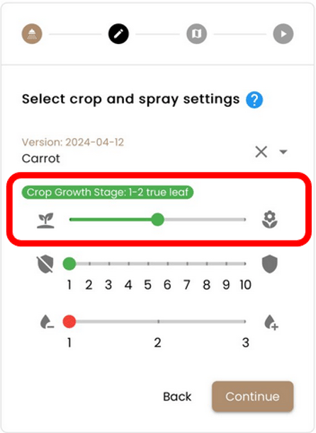
As of 2024, three profiles are available, labelled after the crop growth stage, since this is the main indicator of how difficult it is to recognize plants. The profiles adjust two settings:
- Confidence threshold: How certain the classifier needs to be before deciding to spray a plant.
- Minimum weed size: The size threshold under which any plants are assumed to be a crop. Used for the smallest growth stages in crops where separating seed leaves from weeds is very challenging.
Advanced: Limitations of the Classifier
Using machine learning is the key to automatically recognizing plants from a photo but comes with a few unintuitive limitations. It is the purpose of this section to explain these limitations and how they are best overcome, to give a better understanding of what kind of data is needed and why.
The main consideration when deploying a new classifier is what data has gone in to building it. The classifier can be thought of as a statistical model which has learned to recognize plants by processing thousands of images. The main drawbacks from this approach are:
- The classifier only knows what it has seen
- The classifier will cheat if possible
An example of a problem caused by 1) is that if the classifier has only seen images of plants at a seed leaf stage, it cannot infer what the true leaves look like. A more devious problem might be that the classifier has only seen a certain cultivar, it might not recognize another to be of the same species of plant.
An example of a problem caused by 2) is that if the classifier has only seen crops of a certain kind growing in a very particular kind of soil, then it might “cheat” by using the appearance of the soil to make its predictions about the plants present.
The solution to both these problems are luckily the same: More and varied data.
- Given enough data the classifier will learn general rules for recognizing the core characteristics of a plant species, allowing it to handle cases it has never seen before.
- Given enough data the classifier will learn to ignore unimportant but correlated features like soil type and focus exclusively on the appearance of the plants themselves.