![kilterlogo big_big.png]](https://learn.kiltersystems.com/hs-fs/hubfs/kilterlogo%20big_big.png?height=40&name=kilterlogo%20big_big.png)
The AX-1 performs best in flat fields and raised beds and should not be used in ridge systems or in fields with highly uneven profiles (see Figure 1). Field shape directly determines whether the robot can drive on safe, repeatable wheel tracks and reach weeds without the crop or bed edges blocking the view, so bed width must match the machine’s track and boom configuration, check the centre-to-centre (C–C) wheel spacing and make sure the boom and spray modules line up inside the bed. Uniform bed height, straight and consistent bed edges, and even spacing along each row are important because sudden changes in bed height or side slopes create blind spots, unstable wheel contact and a much higher risk of the robot getting stuck. Headlands must be open and crop-free so the AX-1 has room to turn at the end of each row, and both tracks and headlands should be clean and level, with no deep ruts, obstacles or encroaching vegetation. While the mobile app allows operators to trim or extend recorded rows, or to edit headland areas in the field, these software fixes do not replace good physical preparation: whenever possible prepare beds so their width, shape and surface are consistent for the full length of the run.
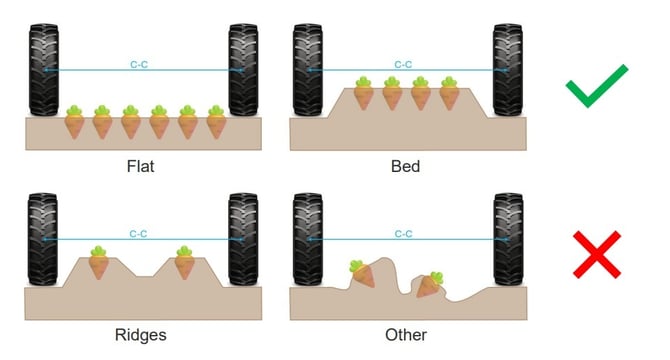 Figure1 Supported field profiles